*These statements have not been evaluated by the Food and Drug Administration. This product is not intended to diagnose, treat, cure, or prevent any disease.
© 2025 Reborn. All rights reserved.

The 100-Year-Old Molecule Big Pharma Never Told You About

Methylene blue was first synthesized in 1876 by a German chemist named Heinrich Caro. That makes it, by most accounts, the oldest synthetic medicine still in use today. It is older than aspirin. Older than the light bulb in your kitchen.
And in the 150 years since, scientists have not stopped studying it. Search the U.S. National Library of Medicine and you will find tens of thousands of published references touching this one blue compound — malaria wards, emergency rooms, microscope slides, and, more recently, the mitochondria inside your cells.
That is the first thing to understand. This is not a trend somebody invented last year to sell you something. The paper trail is a century and a half deep.

Your brain is guarded by something called the blood-brain barrier — a filter that keeps the vast majority of compounds out. Most things you swallow never get anywhere near your brain tissue. That is by design; it is protection.
Methylene blue is one of the rare molecules small enough and fat-soluble enough to pass straight through it. That single property is a large part of why researchers kept circling back to it for the brain specifically. It is not just studied for the brain. It actually reaches the brain.
There are 22,000 studies. This isn't new. I'm new to it.
Russell Brand
A number like 22,000 is easy to say and hard to picture. So here is what a century of researchers were actually looking at, era by era.
1890s onward: a treatment for malaria — one of the first synthetic drugs ever used against a disease.
Early 1900s: the standard antidote for methemoglobinemia, a blood condition that starves the body of oxygen. It is still on the World Health Organization's list of essential medicines for exactly this.
Throughout: a laboratory stain, because it binds to tissue and turns it a vivid blue — the reason it exists in almost every lab on earth.
Modern era: mitochondrial function, oxidative stress, cognitive performance, and neuroprotection. (See Rojas, Bruchey, and Gonzalez-Lima, Progress in Neurobiology, 2012, for one of the foundational reviews.)
Different centuries. Different questions. Same blue molecule that kept earning another look.

Inside almost every cell you have sit tiny structures called mitochondria — the part of the cell that produces energy. They run food and oxygen through a chain of reactions called the electron transport chain, and the end product is ATP, the currency of energy your body spends on every thought, heartbeat, and muscle contraction.
In that chain, methylene blue can act as an alternative electron carrier — it can accept and donate electrons at points where the natural process sometimes bottlenecks. Researchers have studied this mechanism extensively, and the research suggests that, at low doses, methylene blue may support mitochondrial ATP production and may help the body's antioxidant defenses against oxidative stress.

Here is the part that trips people up. If a molecule has 150 years of history and tens of thousands of studies behind it, why did nobody tell you?
Because nobody owns it. Methylene blue's patents expired generations ago. No company can lock it down, so no company will spend hundreds of millions of dollars marketing it to you the way they market a brand-new pill. Old, cheap, unpatentable compounds do not get television commercials — not because they don't work, but because there is no fortune in reminding you they exist.
So it sat quietly in the medical literature, doing what it does, while the rest of the world slowly caught up. That is the whole story. As Russell said: it isn't new. You are just new to it.
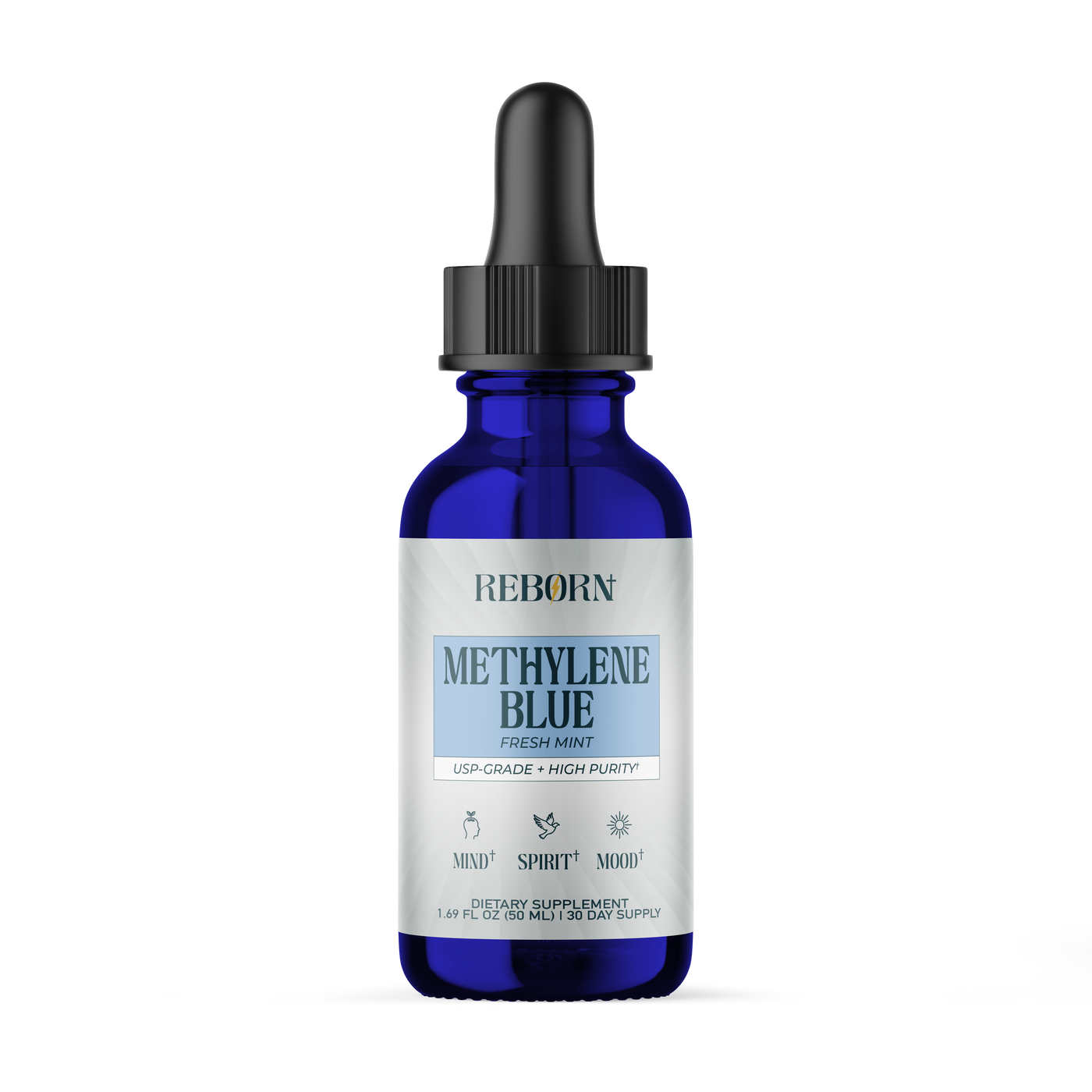

“I made this for the days I want to feel like myself again.”
— Russell Brand, Founder

Third-party tested, pharma-grade, made in the USA. I wouldn't put my name—or my soul—on anything less.
*These statements have not been evaluated by the Food and Drug Administration. This product is not intended to diagnose, treat, cure, or prevent any disease.
Third-party tested, pharma-grade, made in the USA. I wouldn't put my name—or my soul—on anything less.
*These statements have not been evaluated by the Food and Drug Administration. This product is not intended to diagnose, treat, cure, or prevent any disease.
“I made this for the days I want to feel like myself again.”
— Russell Brand, Founder